



The Golden Ray from Pettenasco to Legro, "Painted Village"
Úroveň náročnosti: T2
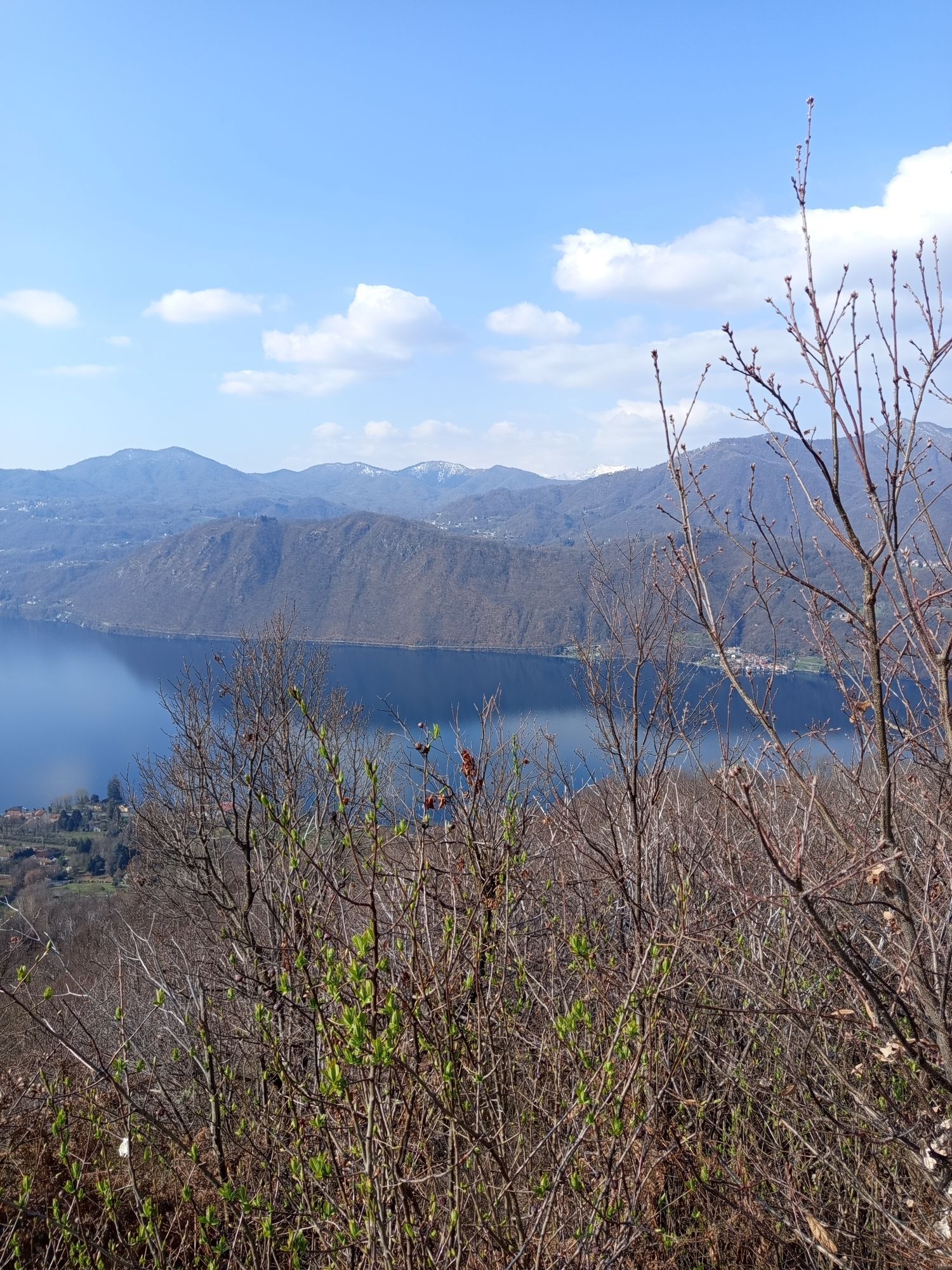
Although you can reach the Paganetto picnic area by car, we recommend parking near the church or the lakeside promenade, if possible, so you can walk through the village of Pettenasco and admire the beautiful...
From the church, cross the main road to take Via Vittorio Veneto (be careful, there is no sidewalk), which leads uphill first to the Museum of Woodturning Art and then to the intersection with a small chapel (fountain). Immediately afterward, take the road on the right (brown sign "Paganetto picnic area") that passes under the tall railway bridge. Staying on the asphalt road, you'll reach the picnic area, preceded by an old ivy-covered bridge. A short detour takes you up the steps on the left to the base of the bridge, near the stream bank with an old fountain and a statue of the Madonna. Shortly after the bridge, take the dirt road on the right (sign VU9 Carcegna-Miasino) that gradually climbs until it almost touches the railway, then follows it, becoming paved in places. At a gate, turn sharply left, climbing more steeply until it joins a wider dirt road that continues to the right, now more gradually. Enter the houses of Carcegna along Via Roma. Staying on Via Roma and ignoring the misleading multi-colored signs, you will reach a crossroads near the Church of San Pietro Apostolo. Cross the crossroads to reach the church, behind which there is a small playground. Follow a short stretch of paved road and almost immediately turn left (sign "Miasino–Legro"). After a building housing the workers' club, pay attention and turn right onto the smaller grassy road (be careful, if you go straight you'll enter private property!), which leads across a meadow and then to a small bridge over a small stream, before climbing up a flight of steps.Once at the top, take the dirt road on the left, which shortly becomes paved, still slightly uphill. From this point, continue straight, while to the right opens up a view of the lake and the Orta San Giulio peninsula. You reach the hamlet of Miasino, entering under an archway that leads to the cobbled streets. Alternative route: the route continues to the right, but we recommend taking a detour to the left through the village streets. You pass by the imposing Villa Nigra, a magnificent aristocratic country residence with wings dating from various periods, from the 16th to the 18th century.
Under municipal management, it now hosts events, exhibitions, and concerts. From here, follow the signs for the Church of San Rocco, a grand building rising above the village with several grassy steps (benches and a fountain). You've now reached the highest point of the entire route. Also nearby is the Giardino dei Semplici, a botanical garden with a collection of plants mentioned in the Bible, while just behind the bell tower are a soccer field and a volleyball court. From the crossroads, continue along the cobblestone road until you reach a crossroads. Turn right onto a stretch of asphalt (be careful, there's no sidewalk!). Leave it after 300 meters to take a dirt road on the right (signposted "Legro-Orta") that descends through a wooded area. The dirt road turns to asphalt, and at the end, turn left. Once you reach the crossroads, cross it and head toward the two gates opposite: between the two begins Via Vecchia Stazione, dotted with the first film-themed murals. You've arrived in Legro, known as "the painted village" due to the numerous frescoes scattered across the facades of its houses and streets, all linked to films shot on Lake Orta. You can find them all while wandering around this village.
Towards Orta San Giulio
- Elevation gain: 100 meters downhill one way
- Distance: 2 km one way
- Travel time excluding stops: 45 minutes one way
Once you reach the railway station, cross it via the underpass and head towards the sports facilities. Continue along the path to Via Marconi, near the roundabout where the imposing Villa Crespi stands.If for some reason you can't take this path, simply continue with the railway line on your right until you pass the station and reach Via Marconi. Here, turn left and descend to the previously mentioned roundabout, or take the smaller Via Don Giovanni Bosco, which runs parallel to it and is free of traffic. From the roundabout, the Moorish villa appears in all its elegance, now a luxury hotel and restaurant run by a renowned Italian Michelin-starred chef. We are now in Orta San Giulio, one of the "Most Beautiful Villages in Italy" (www.borghipiubelliditalia.it).
Turn right next to the villa, take Via Fava, which quickly leads along the lakeshore to Piazza Mario Motta, home to the pier and numerous restaurants. At one end stands a curious frescoed building with a staircase: this is the Palazzo della Comunità. Built in 1582, it was the seat of government for the feudal state of the Riviera di San Giulio and is today also known as Broletto or Palazzotto. Orta unfolds through a maze of intricate and seemingly chaotic streets.
Simply stay on Via Olina, which continues behind the Palazzo della Comunità, to explore the most typical alleys and gardens, or climb right onto Via Caire Albertoletti, also known as the "salita della Motta," to admire some of the oldest buildings. Casa Marangoni (14th century), for example, is also known as the "House of the Dwarves" due to the small windows that adorn its upper section, supported by a long wooden architrave and decorated with frescoes.


Signage: white/red “VU9” signs and white/red signs
Pettenasco is 20 km from the Arona exit of the A26 motorway, then head towards Gozzano and then Orta San Giulio and Pettenasco, located on the eastern shore of Lake Orta.
By train: Novara-Domodossola line, Pettenasco station (www.trenitalia.com).
By boat: Orta-Omegna line, spring to fall (www.navigazionelagodorta.it).
Parking is available along the provincial road near the parish church or the pier. Alternatively, park at the Paganetto rest area.
T2
A walk accessible to (almost) everyone but not accessible to strollers.
There are several options for the return journey. You can simply go back the same way you came. You can take the Novara-Domodossola train from the Orta-Miasino railway station (which is actually in Legro!). Finally, it's highly recommended to extend the route on foot to Orta San Giulio and, from there, return to Pettenasco by boat towards Omegna (not in winter).
Obľúbené výlety v okolí
-
Tour of Lake Orta
svetloMountainbike 35,4 km -
4,7
Coiromonte - Monte del Falò
strednáTuristika 6,16 km -
5,0
Baveno - Monte Camoscio - Monte Crocino - Stresa
ťažkéTuristika 10,7 km -
On the Hills from Cavallirio and Boca
svetloTuristika 9,73 km -
5,0
Meina to Stresa
strednáElektronický bicykel 34,8 km -
From Grignasco to the Crag of Ara
svetloTuristika 6,94 km -
From Invorio to Armeno through the villages of Vergante
strednáMountainbike 41,0 km -
4,0
San Giuda Taddeo - Mottarone - Alpe Nuovo - Rifugio Genziana
strednáTuristika 4,63 km -
Green loop trail of Lake Orta
ťažkéMountainbike 50,4 km -
Lagoni di Mercurago Park
svetloMountainbike 12,5 km
Turistika a stopovanie

Nenechajte si ujsť ponuky a inšpiráciu na ďalšiu dovolenku
Vaša e-mailová adresa bol pridaný do poštového zoznamu.