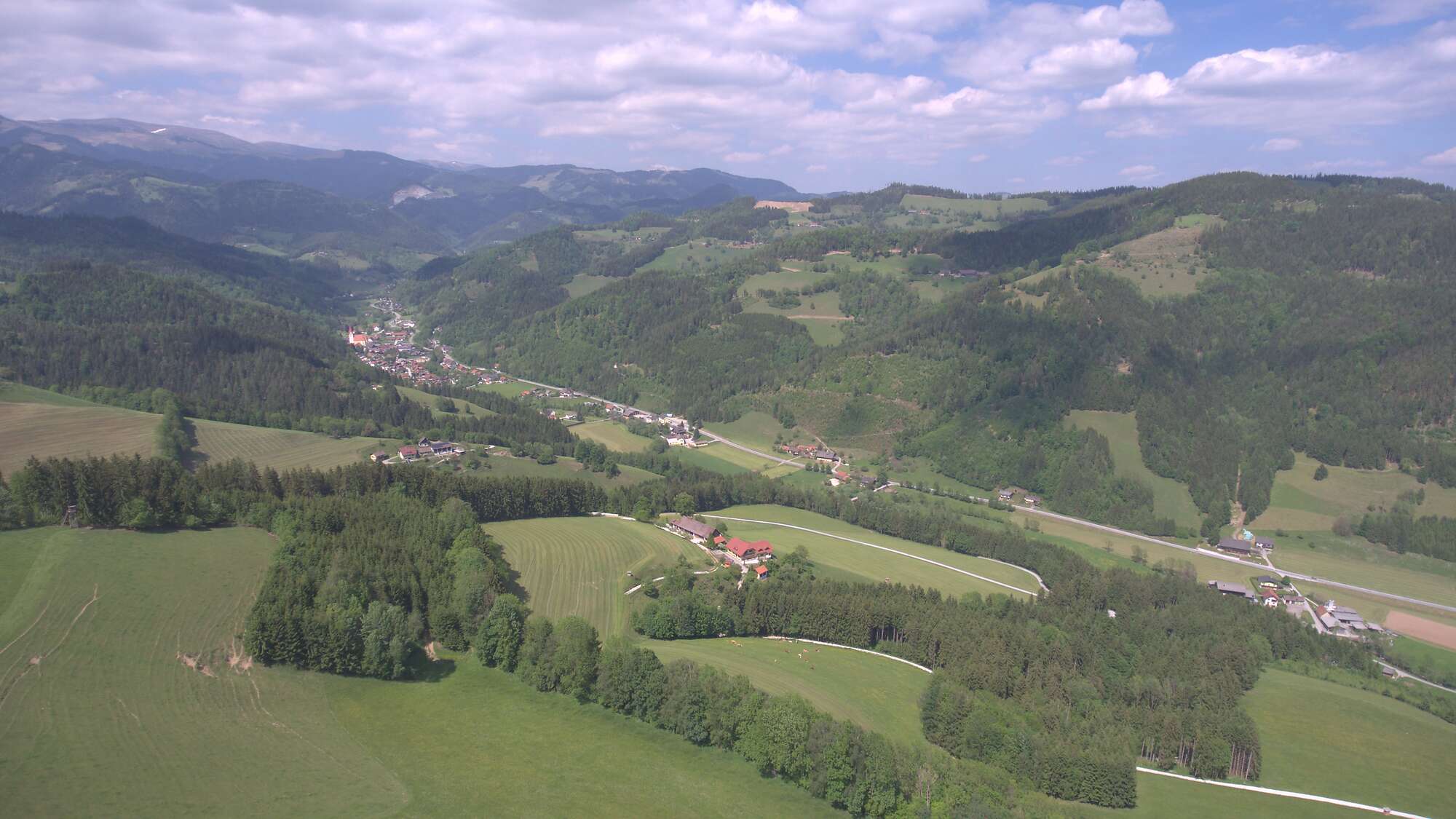
Places of interest in Kainach near Voitsberg
Parish Church
It is dedicated to St George, suggesting that it was founded some time ago, and was first mentioned as early as 1245. Only the west tower remains of the original building. It was previously thought that construction began during the tenure of the parish priest Hans Mauerschwanger (1504 to 1531/32), that it was continued by Urban Gutman (parish...
Places of interest in Kainach near Voitsberg
Parish Church
It is dedicated to St George, suggesting that it was founded some time ago, and was first mentioned as early as 1245. Only the west tower remains of the original building. It was previously thought that construction began during the tenure of the parish priest Hans Mauerschwanger (1504 to 1531/32), that it was continued by Urban Gutman (parish priest from 1533 to 1557), but was only completed under Petrus Steindorfer (parish priest from 1574 to 1585) – that is, after a construction period of around 60 years – that it was finally completed.
However, the interior renovation carried out in 2004 revealed plasterwork in the tower dating from the Romanesque and Gothic periods, suggesting that it is now more likely that the tower was restored and the church was extended and rebuilt during this period. Perhaps this work is connected to the church fire recorded in the visitation report of 1544.
The present nave was added between 1722 and 1725. Between 1722 and 1725, the new church was built as a pillar church with galleries. However, of the two planned side chapels, only the one on the right was actually built as a chapel. Its counterpart serves as a sacristy. The similarity between the church in Kainach and the St. Blasen branch church in St. Lambrecht, built almost at the same time, is striking.
Once the new building was completed and the majority of the interior furnishings (high altar, side altars, pulpit) had been finished, Abbot Kilian Werlein (1724–1737) was able to invite guests to the consecration, which was solemnly performed on 29 May 1729 by the Prince-Bishop of Seckau, Jakob Ernst Graf von Liechtenstein. On this occasion, the four altars were also consecrated.
The church boasts beautiful Baroque furnishings dating from around 1730. Particularly noteworthy are the richly decorated high altar, the side altars, the pulpit, the organ and the crucifix in the side chapel. The altars are the work of Balthasar Prandstätter’s ‘Judenburg School’.
Following the extension of the parish church, a separate section known as the ‘blacksmiths’ gallery’ was built beneath the music gallery at the instigation of the Kainach blacksmiths. The following inscription is found on the rear wall of the nave:
Funditus erectum 1422 (What had been built was destroyed)
Rece(n)us aedificatum 1725 (Rebuilt)
Coloribus pictum 1890 (Painted)
Renovatum 1967 (Renovated)
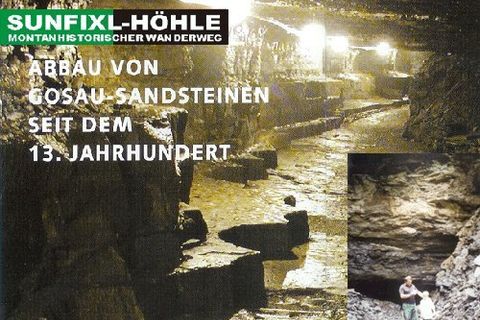
In 1974–75, the church underwent a thorough external renovation, and in 2004, the interior was renovated. On 17 October 2004, Auxiliary Bishop Dr Franz Lackner OFM consecrated the new people’s altar and the ambo (lectern, pulpit). The people’s altar – designed by the artist Gustav Troger, a native of Kohlschwarz-Bärnbach – was constructed from Kainach marble sourced from the Lehnhart quarry (supplied by Kurt Kleinhofer), whilst the ambo was made from sandstone from the ‘Sunfixl Cave’ on the Hemmerberg. Permission to quarry this stone was granted by Mayor August Raudner and the family of Josef Kolb, commonly known as Sunfixl.
Roman stones
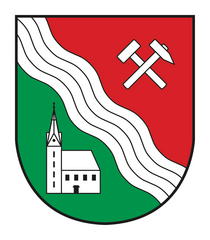
Roman stones are embedded in the exterior walls of the Neuhäusl inn and the chapel opposite. The Roman stone in the inn’s exterior wall served as the model for the design of the Kainach municipal coat of arms.
Rainer Fountain
The Tyrolean artist Rainer Rainer, who has roots in Western Styria, designed the fountain in front of the Kainach Volunteer Fire Brigade’s fire station. It depicts St Florian, the patron saint of firefighters.
War Memorial
On the church square, the memorial commemorates those who fell in the First and Second World Wars. Every year, the Austrian Comrades’ Association holds a memorial service on the last weekend in October.
Kissold Hube
The famous sculptor and poet Prof. Gustinus Ambrosi spent many years of his holidays at the so-called Kissold Hube.
Summer pastures of the Lipizzaner horses – Brentlalm
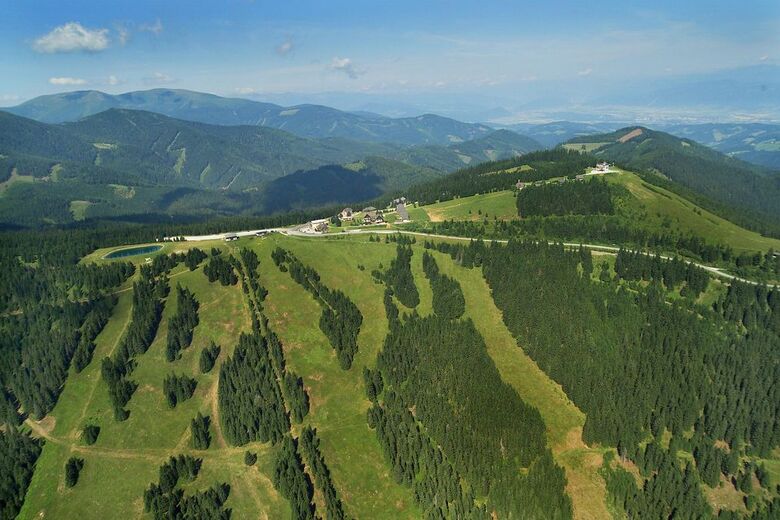
The world-famous Lipizzaner horses have their summer pastures in the upper Kainach Valley – at the Brentlalm.
Pilgrimage Church of the Holy Water
The small pilgrimage church of the Holy Water, nestled in the countryside, is situated on the western side of the Lukaskogel at an altitude of approximately 900 metres above sea level. Dedicated to St Radegundis, the church was built between 1659 and 1669 next to a healing spring. Ms Dorothee Kleinmann from Darmstadt in Germany, who researches the veneration of St Radegundis in Europe, writes: “Heilig Wasser strikes me as the most interesting Radegundis shrine in Styria, if not in the entire German-speaking world.” The founding legend recounts that the water near the church restored the sight of various people. Some believe that the spring was already a pre-Christian water sanctuary, which was later Christianised.
Hauenstein Castle Ruins
It is a typical example of a Gothic tower castle, meaning that the tower was the only residential and service building within the castle and served almost exclusively for military defence purposes. The ruins have been and continue to be lovingly preserved from decay by Prof. Dr Ernst Lasnik and many volunteers. They can now be visited again, and once you have seen them, you will realise that this is a gem well worth seeing.
Sunfixl Cave
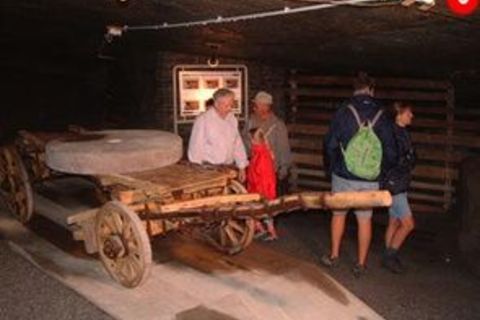
A particular attraction is the Sunfixl Cave, which can be visited by prior arrangement (03148/23 174). Information on the extraction of grindstones in the Sunfixl Cave can be found in The Geology of the Graz Uplands: “Today, Gosau sandstone is hardly used at all; it was quarried mainly on the Hemmakogel near Afling, partly in underground quarries.” In recent years, a mining history trail has been established in the Sunfixl Cave. The large surface quarries and extensive underground workings constitute an interesting monument to mining history.
Naplánujte si dovolenku


Kontaktujte nás



Turistika a stopovanie



Nenechajte si ujsť ponuky a inšpiráciu na ďalšiu dovolenku
Vaša e-mailová adresa bol pridaný do poštového zoznamu.