





THE HISTORY OF BRITTANY IN 16 MURALS
Do you love the history of Béziers? We understand. So let us take you on a stroll, through the time and space of this city, with these frescoes that have much to tell you!
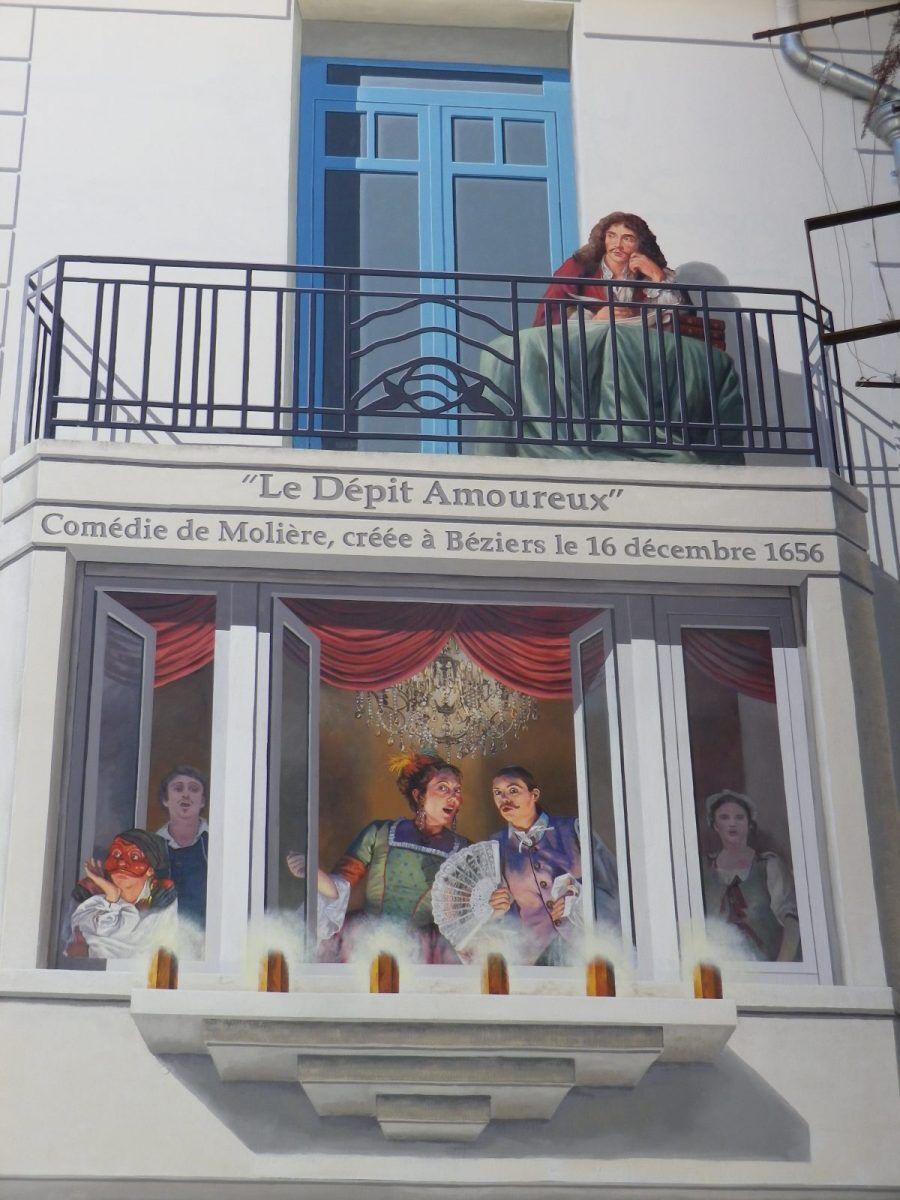

1- Molière and "Le dépit amoureux
Monsieur Poquelin and his troupe have experienced some setbacks. But the protection of the Duc d'Orléans, brother of the King and governor of Languedoc, who was very comfortably housed in Pézenas, allowed Moliére and his people to create, perform, entertain and attract an ever-increasing audience. Thus in 1656, a year before leaving Languedoc, Molière created a play in 5 acts, "le dépit amoureux". It is given place de l'Ancienne Comédie (just behind the building where this fresco is painted).
2- The arrival of the train at Béziers station
The station at Béziers was inaugurated on 19 January 1858, the first train « Bordeaux-Sète » stopped there on 22 April. Freight trains only: the railway did not open to passenger traffic until September 1859. Station, line, track, equipment, personnel: everything was financed by the Compagnie des Chemins de Fer du Midi et du Canal Latéral à la Garonne. With a name like that, it is not surprising that the company -created in 1852 by the Pereyre brothers- is closely linked to the Canal du Midi and its little brother on the Garonne... The company also operates the two canals: it is the company that has had thousands of plane trees planted on the banks of the Canal, all along the route! The company thus nurtures a double Atlantic-Mediterranean link: by rail and by river. 2 amusing details about this fresco: look closely at the face of the locomotive driver: does his face remind you of anything? Of course it does: it's Jean Gabin's, the sacred monster of French cinema, in one of its pre-war flagship films, La Bête Humaine. He plays a compulsive criminal who drives Lison, a steam locomotive (the film, released in 1938, was directed by Jean Renoir, after a story by Emile Zola). How can you tell that you are in Béziers station? On the fresco, you see people who live with and in the station (the station master, the driver, travellers in full dress), but not the building. And now, look up before you go through the main door and take a good look at the central medallion: it represents... a camel's head, a camel, a typical Béziers animal. The Compagnie des Chemins de Fer du Midi disappeared in 1938, absorbed by the fledgling SNCF, but Béziers remains a special place: it is the collection centre of SNCF memory in Occitania!
3.
3- The Way of Compostela (Place des casernes)
This path, "lo camin roumieu" (the road to Rome) comes from Arles, arrives in Béziers via St Thibéry, then continues in the plain towards Capestang, Carcassonne. Hence its name "chemin du piacute;mont". This route is an alternative to the mountain route (Bédarieux/Castres/Toulouse). Long in disrepute, it is now being revived. The "Compostelle" fresco painted on the Place des Casernes, is very close to the church of St Jacques and the pilgrims' halt (the "lo bon camino" -the good way-, opened in 2016). And so as not to lose it, this path, in all the crossing of Béziers the jacquaires as the one who animates the fresco, repèrent on the ground, the bronze cabochons bearing the shell and the name "lo camin roumieu"...
4- The 1907 winegrower's protest (corner rue St Jacques)
Marcelin Albert, a cafe-owner and winegrower from Argeliers (Aude), leader of the movement; as well as an infantryman from the 17th Ré Line Infantry Regiment (from Béziers, whose conscripts are sons of winegrowers, winegrowers themselves) are represented. The origin of the crisis? In 1907, the Languedoc region supplied large quantities of wine, but wines were massively imported from North Africa and others, artificial ones, were produced in fraud. Prices fell considerably, regularly and severely. The winegrowers fall into poverty. So they turn around. Up to 800,000 Languedoc people demonstrate in Montpellier, after Narbonne, Carcassonne, Nîmes. The State responds with pressure, sends in the army. But Béziers, in front of 160,000 demonstrators, on the 17th, "put baïonnette in the ground, refusing to shoot his own people"... Hence the tribute paid in the fresco. And in a song that all Languedocans know. In the summer of 1907, faced with the "contagion" of the movement, the National Assembly voted for laws against fraud.
So, it is not surprising that the French government is not prepared to accept this.
5- Jean-Antonin Injalbert (corner rue Viennet)
This trompe-l'oeil, integrated with the neighbouring facades (note the forged iron balconies, rigorously identical, "in real and in paint"...), is dedicated to the sculptor from Béziers, shown here with his friend, also a sculptor, Etienne Dalou. Injalbert, born in Biers in 1845, was the son of a stonecutter. At the age of 16, he was a apprentice to an ornamentalist, Paul Théacute;odore, who introduced him to drawing. He financed his studies at the Beaux-Arts with a "Ville de Béziers" grant. He will never forget it. At the age of 29, he won the Grand Prix de Rome. Back in Paris, commissions poured in: statues for the Paris City Hall, the Bir Hakeim bridge, "The Fountain of the Titan" (Plateau des Poies, Biers... 15 years of work). In 1907, Injalbert met Rodin, exhibited in Munich, Rio de Janeiro and Italy. He divided his time between his Parisian studio and the Villa Antonine in Biers, where he invited Camille Saint-Sauml;ns, Laloux and Joffre. Injalbert died in 1933. The Villa Antonine was leased to the town in 1935.
6- Jean Moulin (Place Lavabre)
The most famous of the Biterrois was born in Biers in 1899. After his baccalaureate (obtained at the Lycée Henri IV), he "studied law" in Montpellier, then joined the prefecture. A destiny is on the way. The shop on the ground floor embodies THE passion of Jean Moulin and his "cover" as a Resistance fighter: it is his Niçoise art gallery, opened in 1942. A lover of painting and an excellent draughtsman (the works in the window are his), he exhibited Bonnard, Chirico, Dufy, Matisse, Utrillo, Suzanne Valadon, etc. His "cover"? His activity as an art dealer, which enabled him to move around, with a packed painting under his arm, between the Free and Occupied Zones, to accomplish his mission in the Resistance. Jean Moulin was thus a hero-artist. On 19 December 1964, during the transfer of his ashes to the Panthéon, André Malraux recalled this in his extraordinary speech: "The day when (...) after the war, the French army and the French army, the French army, the French army and the French army...) after having had him tortured, the Gestapo agent handed him something to scream about since he could no longer speak, Jean Moulin drew a caricature of his executioner...»
7- Raimon-Roger Trencavel
This fresco and the place where it is painted, illustrate the wine "DNA" of Béziers. The name of the street, Tiquetone (Tiqueta in Occitan), is the onomatopoeia of the sound of hammers as they bang on the iron circles around the barrel staves. But barrels and coopers also embody the transformation of Béziers, under the "Monarchie de Juillet" (1830-1848) when the bourgeoisie, through its financial power, acquired the right to vote and took control of the city, refusing the austerity imposed by Louis-Philippe. The coopers were the first to go on strike, for this very reason, as the wine industry prospered and Béziers needed space and moved out of its old walls. At this time, the alleys and the statue of Paul Riquet (1838), the municipal theatre (1844), the Pont-Neuf (1846), the canal-bridge (1858) were built...
8- The coopers (rue Tiquetone)
At the window of the 1st floor, he shows his work: Raimon-Roger Trencavel, viscount of Albi, Ambialet and Béziers (fiefs held by the count of Toulouse), and viscount of Carcassonne and Razès (fiefs held by the count of Barcelona who was at the same time king of Aragon). Son of Roger II Trencavel -who died when he was 9 years old- and Adélaïde Toulouse, he was the nephew of count Raymond VI of Toulouse Raimon-Roger épousa Agnès, daughter of Guilhem VIII of Montpellier (the pretty blond girl seen in the window of the 2nd floor). From their union was born a son: Raimond II Trencavel, the last of the lineage.
9- Jean-Baptiste Dortous de Mairan
One of the most brilliant minds in the world. His CV attests to this: - Physicist, mathematician, astronomer, botanist, laureate of the Bordeaux Academy of Sciences - Member of the Royal Academy of Sciences from 1718 (and of the learned societies of London, Edinburgh, Uppsala, St. Petersburg, Bologna...) - Member of the French Academy from 1743, he was a friend of Voltaire. He scanned the skies, discovered a telescope - named M43 -, close to Orion's telescope, and showed that plant life has a circadian rhythm. He studied in Toulouse and Paris before returning to Biers. In 1723, with Jean Bouillet and Antoine Portalon, he founded the Académie de Béziers (which lasted 70 years, then disappeared), intended to "spread in the South the taste for exact sciences". He died on 20 February 1771, at the age of 93, which is extremely canonical for the era. In 1935, the International Astronomical Union named Mairan after a lunar crater 39.49 km in diameter and 2.67 km deep!
The crater was named after the moon's name.
10- St Saëns and his opé Dejanire (Place St Esprit)
Madam, Sir, allow us to introduce you to Camille Saint-Saëns (1835-1921). If the Parisian composer is represented here, on the Place St Esprit, it is for two reasons: 1- he had spirit, otherwise we would never have heard his "Carnival of the Animals" or his famous "danse macabre". 2- on this square, at the bottom left, stands the private house of his friend Castelbon de Beauxhostes (creator of the Béziers arena); and Castelbon had commissioned an opera house in Saint Saumur, which was rightly represented in his arches, famous for their extraordinary acoustics. The operation is "Déjanire", whose poster you can read on the wall. Saint-Saëns stayed with his friend Castelbon in this hotel, as the plaque next to the carriage entrance indicates.
Saint-Saëns
11- Casimir Péret (rue Riciotti)
Casimir Péret was born in Béziers in 1801, even before Napoleon became Emperor of the French (1804). But when Casimir Pereau died in 1855, Napoleon III, after his coup d'état, was proclaimed emperor. An infamy for the fierce Biterrois publican: the Second Republic was proclaimed in February 1848. But Louis-Napolle Bonaparte became president of the Republic. In order to secure a greater and longer power, he foments a coup d'etat in December 1851. But Biers is in revolt, and Casimir Pérez is killed. He loses the battle, is arrested and judged. Some are shot, he is sentenced to prison. And he dies in Cayenne in 1855, trying to escape. Cayenne is depicted in this trompe l'oeil: see the convict's uniform hanging on a nail, the grills on the windows, the portcullis in front of the entrance, the modest vegetable garden, as the convicts used to cultivate it. Above, Casimir Péret figures, à the window, with his tricolour mayor's hat.
12- Harlequin (rear façade of the municipal theatre)
The Béziers theatre, inaugurated in 1844, is said to be "Italian", its décor "en bonbonnière". Carefully preserved and restored, it is still the only one in France to welcome its public during the show season. The dome is therefore original, the facade with its high reliefs by David d'Angers and its Greek colonnades has just been renovated. It is perhaps for everything that it has been classified as a Historic Monument since 1975. And then, as a wink to the history of theatre art, a fresco was created on its back wall as a tribute to the Commedia dell'Arte: the "mother" of all troupes and of modern theatre. By the way, say hello to Harlequin...
13- Jean-Marie Cordier (point avenue Clémenceau/avenue Ml Foch)
Béziers is located on a hill. In the summer, the wells are dry. The women walk down to the Orb, through the street and the Tourventouse gate, and then up the hill with their jars full of water. Until 1827! Because the town puts out a call for tender, which the engineer - and initially locksmith - Jean-Marie Cordier (1785-1859) wins. And on 23 September 1827, he succeeded: Jean-Marie Cordier built a steam engine, installed in a water mill built on the Orb, which pumps and raises some 800,000 litres of water/day to a large cistern on the square in front of the Saint-Nazaire cathedral. The city's fountains were filled with fresh water and supplied the 16,000 inhabitants of Béziers! Jean-Marie Cordier becomes the town's hero. His statue stands above his mausoleum in the town's old cemetery.
The statue was erected in the late 19th century.
14- L'Arlésienne
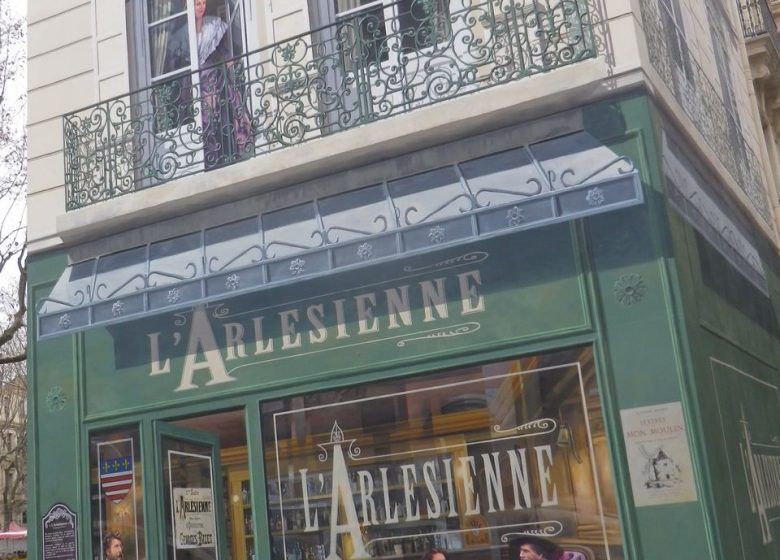
No, the Arlésienne of Alphonse Daudet and Georges Bizet was NOT arlésienne. But from Béziers. Her name was Marie Cauffop, and she lived in this very place, at the corner of Allées Paul Riquet and rue Boïeldieu. Here you see her on her balcony, and below her, sitting at the cafe, Frédéric Mistral and his nephew, François. François was the fiancé of the beautiful one but... this beautiful one was unfaithful. He could not bear this betrayal and committed suicide in 1862. His uncle Mistral told the story to Alphonse Daudet, who transposed it into "les lettres de mon moulin". In his turn, Georges Bizet (also sitting in the bistro) took it up, and composed "l'Arlésienne". Sacréise biterroise va...
15- Trompe l'oeil des 9 écluses de Fonseranes
You can continue the stroll, if you like to "crapahuter" in the city : At the bottom of the avenue de la Marne, you will see the trompe léil dedicated to the 9 écluses of Fonseranes, on the Canal du midi. By the way, you will be right on the way to visit them...
Áno
In case of emergency, call 112
.Think about carpooling
.Parking close to the departure point
.
Získajte prehľad
Vždy naživo na mieste s viac ako 9 500 webovými kamerami. bergfex Ako používateľ Pro si teraz môžete pozrieť príslušné webové kamery pre mnohé zájazdy v aplikácii zájazdy z. Môžete si tak priamo prezerať aktuálne podmienky.
Obľúbené výlety v okolí
-
5,0
PECH BELET HIKE
svetloTuristika 4,41 km -
MOUNTAIN BIKE CIRCUIT 21: LE GRAND SALAN - ESPACE VTT/GRAVEL CAP D'AGDE MÉDITERRANÉE
svetloMountainbike 19,5 km -
LA GRANDE MAÏRE HIKE
svetloTuristika 11,2 km -
OENORANDO® LES COTEAUX D'ENSÉRUNE
svetloTuristika 8,08 km -
HIKING OF THE PASEJADE DEL CRES
strednáTuristika 14,2 km -
5,0
HIKING THE ORPELLIÈRES, TREASURES OF NATURE
svetloTuristika 4,13 km -
OENORANDO® BETWEEN THE CANAL DU MIDI AND THE VINEYARDS
strednáTuristika 10,2 km -
HIKING BETWEEN CANAL DU MIDI AND BEZIERS
svetloTuristika 7,81 km -
CIRCUIT TABARKA ISLAND – BÉZIERS MÉDITERRANÉE VTT-FFC AREA
strednáMountainbike 17,2 km -
OENORANDO® LE PECH DU THOU
svetloTuristika 7,34 km
Turistika a stopovanie

Nenechajte si ujsť ponuky a inšpiráciu na ďalšiu dovolenku
Vaša e-mailová adresa bol pridaný do poštového zoznamu.