



URBAN ROUTE ON THE PILGRIMS' PATH IN SETE
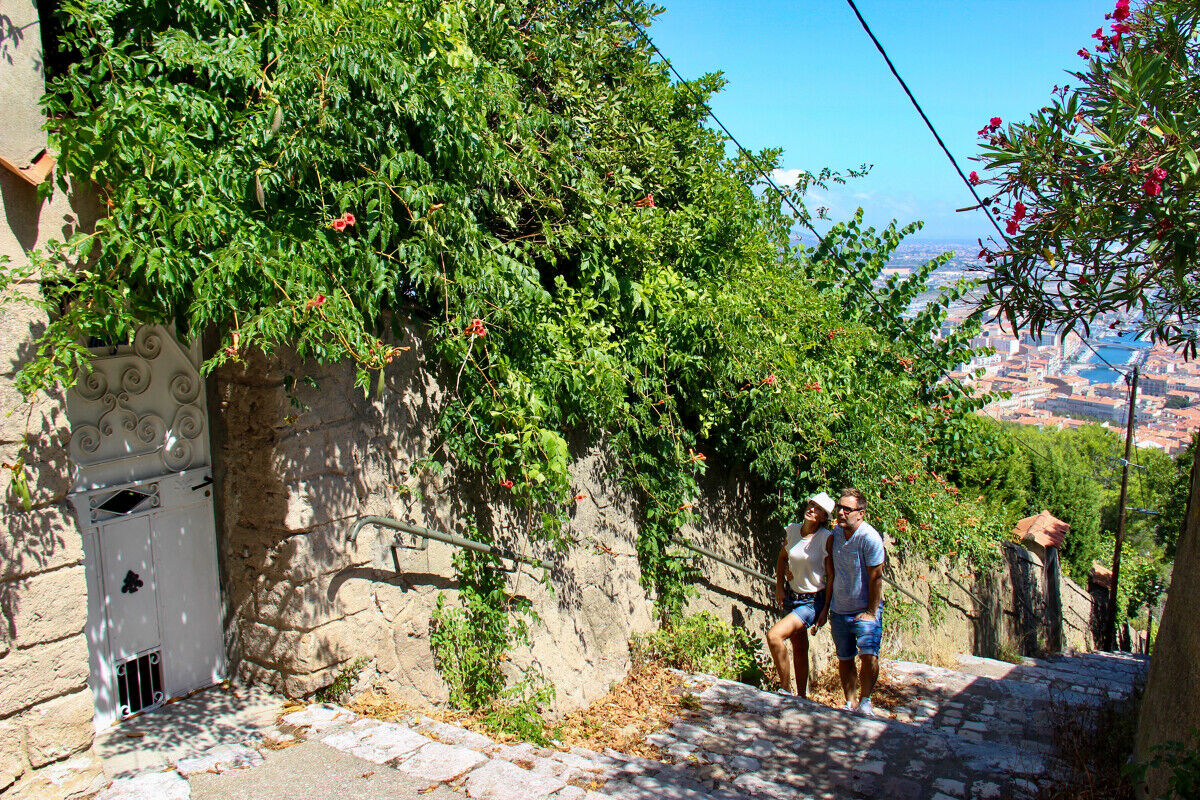
Circuit of the Saint-Clair stairs. The "All the way up" awaits you, offering from its summit a magnificent panorama overlooking the canals (Sète truly deserves the nickname of Singular Island or Little...
Circuit of the Saint-Clair stairs. The "All the way up" awaits you, offering from its summit a magnificent panorama overlooking the canals (Sète truly deserves the nickname of Singular Island or Little Venetian Languedoc), the port, the Saint-Clair cross, and the small Chapel Notre-Dame-de-la-Salette.


1
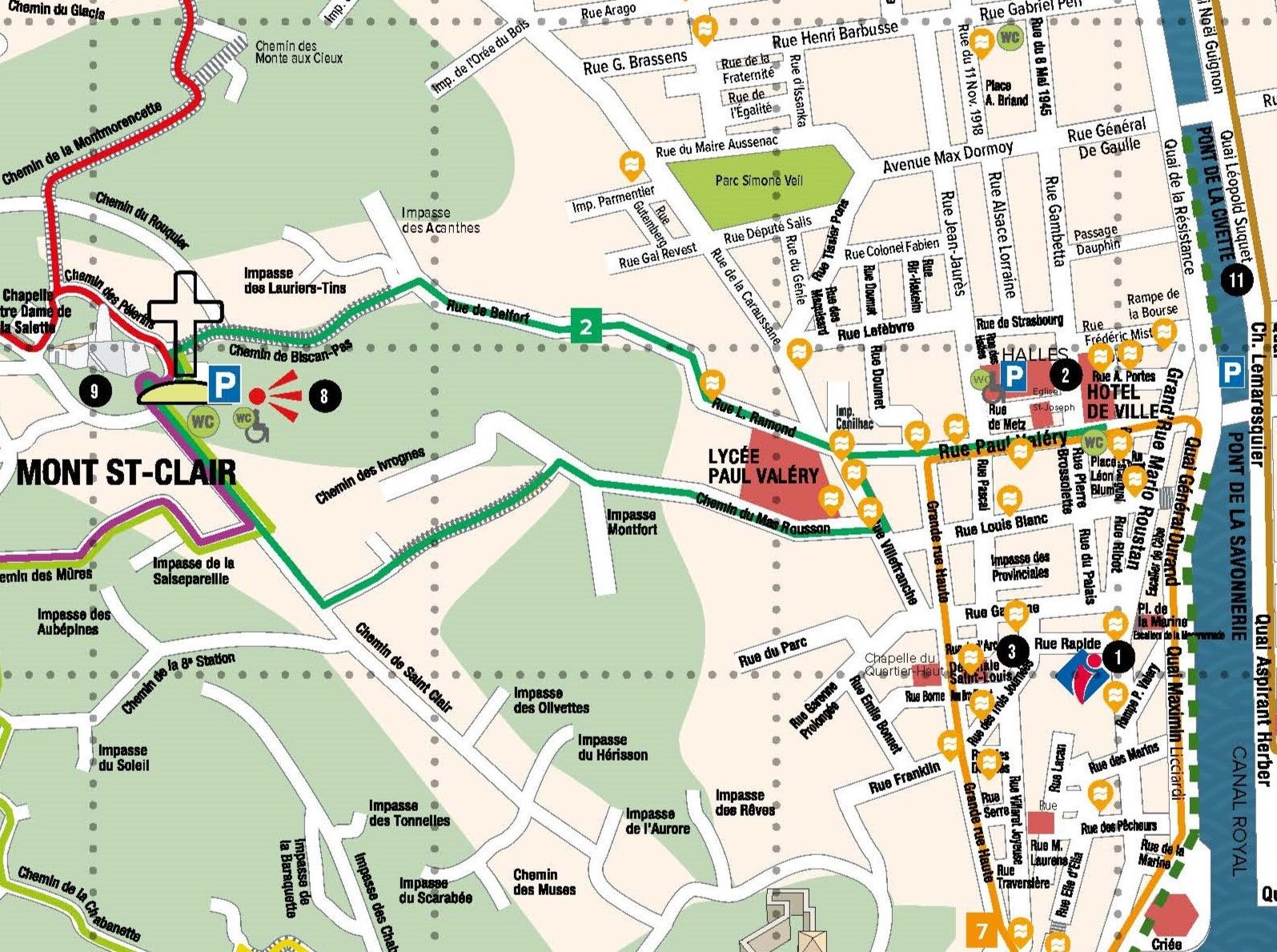
Start in front of the town hall. Facing you, take Paul Valéry Street. The building housing the current town hall is believed to have been built in 1719. It was acquired by the city on May 30, 1724, and from then on became the seat of the municipal administration. Parts of the adjoining buildings served as barracks from 1737 to 1795 (Gambetta Street). The ground floor housed market halls, then the Savings Bank office and the police station before being reserved exclusively for municipal services. The lintel of door No. 22 on Paul Valéry Street is the sole reminder of a bakery built in 1720 where the anarchist Caserio, who assassinated President Sadi Carnot in 1894, notably worked. Paul Valéry was the pen name of Ambroise Paul Toussaint, a French writer, poet, and philosopher. Paul Valéry was born on October 30, 1871, in Sète and died on July 20, 1945, in Paris. Elected member of the French Academy in 1925, he is buried at the Marine Cemetery (known as the Cemetery of the Rich). At the top of Paul Valéry Street is the Paul Valéry high school. In 1836, the city bought land and created a boarding school for boys, which became a communal college in 1844, expanded with a primary school in 1863, “the small college” which lasted exactly a century. Reserved for boys until 1922, when girls were admitted in the final year, it became a high school in 1962. Its monumental door framed by columns overlooks the steps of a staircase "worn by 4 generations of Sète residents", the most famous being Paul Valéry, Jean Vilar, Mario Roustan, Pierre-Jean Vaillard, Georges Brassens.
2
Climb to reach Paul Valéry high school. On the right facing the school, there is a small dead-end: the Canilhac dead-end, also called "le Trou de Poupou". Take Louis Ramond Street (do not heed the dead-end sign, it applies only to cars, not pedestrians). Louis Ramond Professor of Letters, SFIO activist, CGT then CGT-FO unionist, deputy mayor and General Councilor of Sète. Born August 23, 1905, in Sète and died March 9, 1993, in Sète.
3
Belfort Street: Street named in honor, like Metz and Strasbourg streets, of the 1870 war, but here it refers to a town that remained French. This street runs along the Paul Valéry high school and seems to enter the "Erialc villa", former villa of the Chauvain family. The gardens house the Municipal School of Fine Arts founded in 1970 after the city acquired the land in 1967.
4
Biscan Pas Path: Occitan term meaning "don't grumble." There awaits you firmly the staircase with 225 steps (easy to climb and wide).
5
Pilgrims' Path You emerge onto the Pilgrims' Path for an arrival at the summit of Mount Saint-Clair. Itinerary used by the people of Sète during pilgrimages to Saint-Clair. Father Gaffino (1823–1899) established a custom still in force: on the 19th of every month, especially on September 19, the people of Sète climb Mount Saint-Clair on pilgrimage to the Notre-Dame de la Salette chapel where two masses are celebrated at 7 am and 10 am.
6
Summit of Mount Saint-Clair. Enjoy the view (access the building's rooftop terrace for a 360° view) and go admire the frescoes of the Notre-Dame de la Salette Chapel. On this panoramic site are the Notre-Dame de la Salette Chapel and the Saint-Clair Cross (1932). In 1840, 14 stations of the cross were marked in stone along the path connecting the city to Saint-Clair. The chapel was essentially built in 1861 as an extension to a hermitage erected within the remains of a military fort completed in 1710 (southwest side), housing since the late 19th century many ex-votos, which explains its severe exterior appearance. The said chapel was dedicated to the Virgin following her apparition on September 19, 1866, at La Salette, in Isère. The Virgin statue was erected in 1866 to commemorate the bicentenary of the city. What could serve as a bell tower also served as a geodetic marker from 1831. This chapel is a traditional pilgrimage site on September 19. The interior frescoes were painted by Jacques Bringuier from 1951 to 1953. The luminous Saint-Clair cross (1932) continues the fire that the people of Sète lit on July 12 to celebrate the saint who gave his name to the mount. By making a donation of any amount you wish, you can have the illuminated cross light up at night to pay tribute to a loved one or for a symbolic date for you and your family!
7
Saint-Clair Path. On the left descending, about 300/400 meters from the summit is station 9 (number 9 and a cross), and on the corner of this wall is a sign indicating the Mas de Rousson (with a silhouette descending stairs).
8
Mas Rousson Path Take the Mas Rousson path where 389 steps await you, and continuing straight ahead, you will reach Villefranche Street. The Rousson family appears in several municipal administrations. This place-name was mainly in the 1860s the Mas de Rousson, tax collector’s house including stable and vineyards.
9
Villefranche Street You arrive at Villefranche Street. Turn left on this same street to reach Paul Valéry Street. The entire upper district (called "little Naples") is enclosed by Villefranche Street, from Paul Valéry high school to the extended Garenne Street. This street houses several schools: Paul Bert and Louis Pasteur schools. The Dominican school also operated here. Maps from the mid-19th century reveal an empty space along the axis of Mas Rousson path, at the top of Louis Blanc Street, a kind of courtyard now isolated from the street. It is familiarly called by the people of Sète "la Cachiu", meaning the hideout of the Cachous or Poor Italians. Return to your starting point, the town hall.
Casual shoes (no flip-flops or espadrilles). In summer, avoid the midday heat especially with children and preferably walk in the morning or late afternoon. Bring water bottles.
Route not recommended for people who have difficulty walking.
At sunrise or sunset, the panorama is even more splendid.
Amenities: free water fountain in the summit parking, public toilets, café, dining in the high season (20m below on the Saint-Clair path)
+33 4 86 84 04 04


Obľúbené výlety v okolí
-
5,0
MOURE HILLS HIKE
strednáTuristika 13,1 km -
4,0
BALCONS DE THAU HIKE
svetloTuristika 7,04 km -
RANDONNEE DES ARESQUIERS
svetloTuristika 9,85 km -
SAINT-FELIX EN GARDIOLE HIKE
strednáTuristika 13,7 km -
CIT'ART HIKE THE BELVEDERES OF LA GARDIOLE
strednáTuristika 13,1 km -
CYCLE LOOP No. 26 - THAU POND, ABBEY OF VALMAGNE AND PÉZENAS
strednáCyklistika 63,1 km -
BALADE DES GUEULES ROUGES HIKING TRAIL
svetloTuristika 6,16 km -
THAU WINE ROUTE IN THE MEDITERRANEAN
svetloMotorrad 128,5 km -
VIA DOMITIA HIKE
svetloTuristika 4,95 km -
MEDIEVAL ROUTE BETWEEN POND AND VINEYARDS OF THE ARCHIPELAGO OF THAU
svetloMotorrad 27,4 km
Turistika a stopovanie

Nenechajte si ujsť ponuky a inšpiráciu na ďalšiu dovolenku
Vaša e-mailová adresa bol pridaný do poštového zoznamu.