





European Cultural Route "Großostheimer Renaissance"
In the late 16th century, Großostheim experienced an enormous economic boom: from craftsmen's houses to chapels to the defensive tower – there was construction throughout the town. The approximately 3...
In the late 16th century, Großostheim experienced an enormous economic boom: from craftsmen's houses to chapels to the defensive tower – there was construction throughout the town. The approximately 3 km cultural trail through the old town leads to preserved testimonies of prosperity at the transition from late Gothic to early Renaissance.

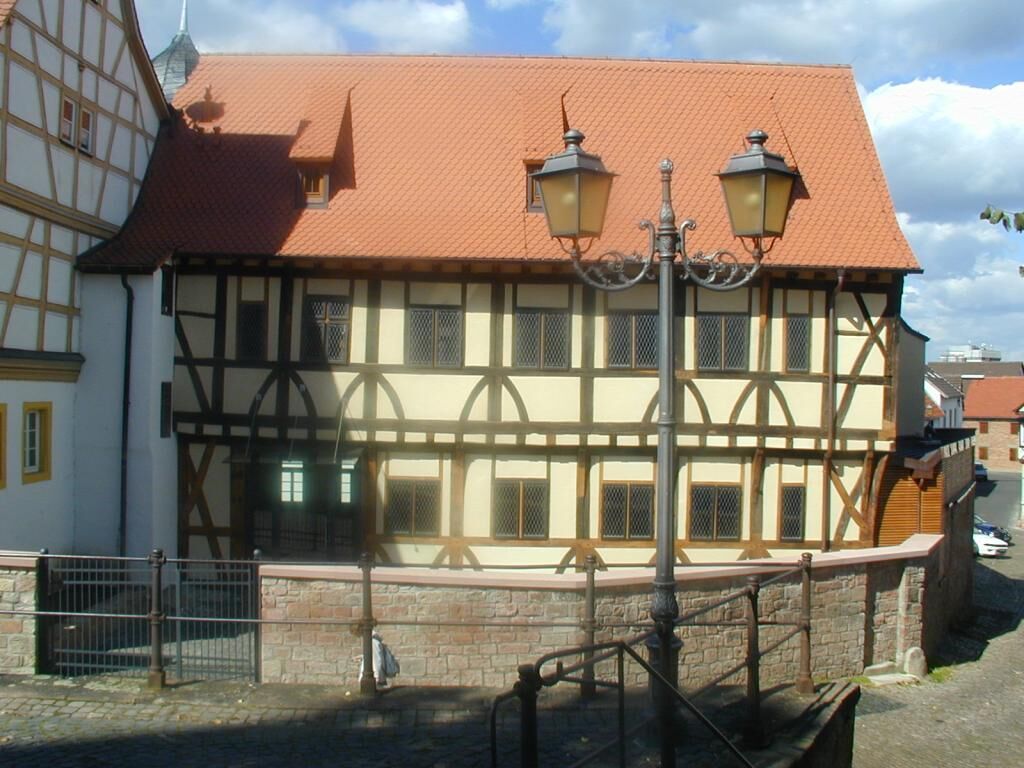

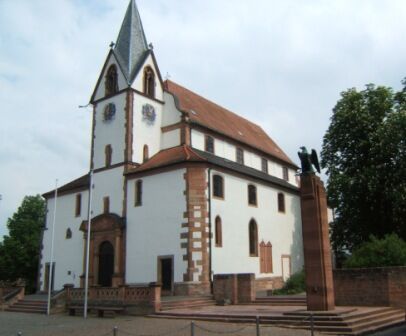

Follow the coat of arms of the market town of Großostheim, starting at the marketplace with its magnificent half-timbered ensemble and the main highlight, the old manor house "Nöthigsgut." The estate belonged to the Mainz Cathedral Chapter, and from 1762 to 1921, the eponymous Nöthig family were tenants of the property. Today, the Bachgau Museum with an exhibition area of about 1100 sqm is housed here (open Sundays 2-5 pm and by appointment). Also under the patronage of Electoral Mainz, the new construction of the St. Peter and Paul Church took place around 1250/70. Among the late Gothic fittings, the Lamentation altar by Tilman Riemenschneider holds an outstanding position.
After leaving the marketplace, we pass through the Old Cemetery, where two tombs of the Nöthig family are located at the rear. We exit the cemetery and stand at the Stumpfer Turm, a round tower first mentioned in 1500. A few meters down Grabenstraße is the Spitzen Turm, from where, by arrangement, a panoramic view of the rooftops of Großostheim is possible. The well-preserved 28 m high Spitzen Turm demonstrates its fortifications through loopholes, dripstones, and battlements. The tower also formerly served as a prison.
Then we follow the circular route along Breite Straße to the Old Town Hall, located on the site of the old tithe barn. Here, natural products were handed over and stored, which were to be delivered to Mainz. Nearby, the wealthy farrier Peter Drippels had the eponymous Drippels Chapel built. The small domestic altar from 1492, called the "Großostheimer Krippchen," contains in fine woodcarving the Nativity of Christ. Further along, one reaches the third preserved tower of the old town fortifications, the Kalk- or Hexenturm, now uncovered. It was built as a defensive tower with battlements and a guard platform around 1500. The tower was where the "painful interrogations" (torture) of persons accused of witchcraft took place.
Then we reach the Schmalzgrube, virtually the Großostheim "black quarter," where day laborers, small craftsmen, and small farmers lived in the small courtyards. The name may originate from the rich, black alluvial soil found here or from the network of narrow alleys. On the main road to Niedernberg stands the Holy Cross Chapel, which contains a special artifact: a crucifixion group made of red sandstone, whose figures are life-sized (1510), originating from the school of Hans Backoffen in Mainz. Another Marian chapel, popularly called "Frauhäuschen," dates from the early 17th century and forms the conclusion of the old town circular walk upon returning to the marketplace.
A3 coming from Frankfurt to Stockstadt exit, then continue on the B 469 towards Miltenberg to Großostheim-Mitte. Then about 3 km to the old town (marketplace).
By train from Miltenberg to Obernburg/Elsenfeld station, then to the Bahnhof-Westseite bus stop, from there continue with bus line 55 to Großostheim-Schaafheimer Straße (northern town center) and about 500 m to the marketplace.
Directly at the marketplace (2 hours with parking disc) or at the cemetery.
Obľúbené výlety v okolí
-
4,0
Rückersbacher Schlucht
strednáTuristika 15,3 km -
5,0
Kulturweg Niedernberg: Blechkatzen im Honischland
Turistika 10,2 km -
Obernburg - Eisenbach round
strednáTuristika 10,7 km -
3,0
Elsenfeld district Rück: Across the vineyards past the Red Cross to Hofstetten, return over the Hochberg to the parking lot
ťažkéTuristika 10,6 km -
4,0
Elsenfeld district Rück: Via Eichelsbach and the Himmelthal monastery through the vineyards back to the car park in Churfranken
ťažkéTuristika 9,32 km -
European Cultural Trail Großostheim: "Fruits of the Loess"
strednáTuristika 6,25 km -
5,0
MainRadweg Miltenberg bis Aschaffenburg
Cyklistika 42,8 km -
Franconian Red Wine Hiking Trail - 2nd stage from Großostheim to Elsenfeld
ťažkéTuristika 17,2 km -
Mountain bike circular route Obernburg - Eisenbach
strednáMountainbike 32,3 km -
Sulzbach Forest Adventure Trail
svetloTematická trasa 3,25 km
Turistika a stopovanie


Nenechajte si ujsť ponuky a inšpiráciu na ďalšiu dovolenku
Vaša e-mailová adresa bol pridaný do poštového zoznamu.